
Ingredients
Equipment
Method
Prepare the Beef
- Partially freeze the eye of round roast for 1-2 hours; this makes it much easier to slice thinly.
- Using a very sharp knife, slice the beef against the grain into uniform strips, about 1/8 to 1/4 inch thick. Trim off any visible fat, as fat can cause jerky to spoil faster.
Marinate the Beef
- In a large non-reactive bowl, whisk together the soy sauce, Worcestershire sauce, apple cider vinegar, liquid smoke, brown sugar, garlic powder, onion powder, black pepper, red pepper flakes (if using), smoked paprika, and pink curing salt (if using).
- Add the sliced beef strips to the marinade, ensuring all pieces are fully submerged and coated. Use your hands to mix thoroughly.
- Cover the bowl and refrigerate for at least 6-8 hours, or preferably overnight (up to 24 hours), to allow the flavors to penetrate the beef. Stir occasionally if possible.
Dehydrate the Jerky
- Remove the beef from the marinade and pat each strip thoroughly dry with paper towels. This step is crucial for efficient dehydration and to prevent a leathery texture.
- Arrange the beef strips in a single layer on your dehydrator trays, ensuring no pieces are overlapping.
- Set your dehydrator to 160°F (71°C) if using pink curing salt, or 145°F (63°C) if not, to ensure food safety.
- Dehydrate for 4-8 hours, or until the jerky is dry, firm, and pliable but not brittle. It should bend without breaking. The exact time will depend on your dehydrator, the thickness of the meat, and the humidity.
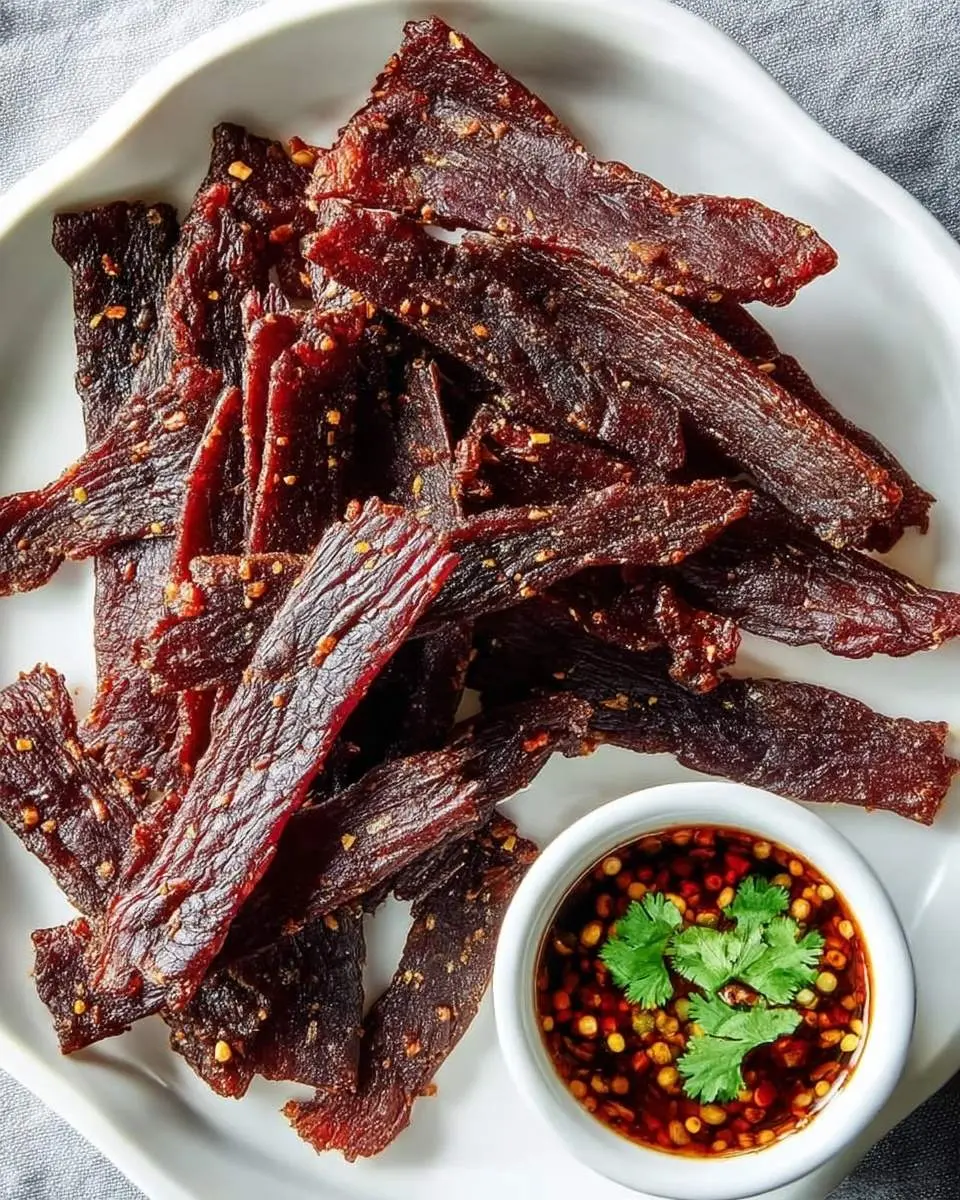
- Check for doneness after about 4 hours, and then every hour or so. To check, cool a piece to room temperature and bend it. If it cracks but doesn't break, and you see fibrous white strands (not red or wet), it's done.
Cool and Store
- Once done, let the jerky cool completely on a wire rack at room temperature for several hours (or overnight) to prevent condensation and mold formation during storage.
- Store the cooled beef jerky in airtight containers or resealable bags at room temperature for up to 1-2 weeks. For longer storage (up to 1-2 months), refrigerate it.
Notes
Meat Selection: Eye of round, top round, or flank steak are excellent choices due to their leanness. Always trim all visible fat.
Against the Grain: Slicing against the grain makes for more tender jerky. Slicing with the grain results in chewier jerky.
Curing Salt: Pink curing salt (Prague Powder #1) is recommended for longer preservation and a more traditional jerky texture and color. Use 1/4 teaspoon per pound of meat. If omitted, ensure beef is dehydrated at a higher temperature (160°F/71°C initially for 1-2 hours then reduced to 145°F/63°C) and stored in the refrigerator.
Oven Method: If you don't have a dehydrator, you can use your oven. Preheat oven to the lowest possible setting (usually 170-200°F/77-93°C). Prop the oven door open slightly with a wooden spoon to allow moisture to escape. Arrange strips on wire racks placed over baking sheets. Dehydrate for 3-6 hours, checking frequently.
Against the Grain: Slicing against the grain makes for more tender jerky. Slicing with the grain results in chewier jerky.
Curing Salt: Pink curing salt (Prague Powder #1) is recommended for longer preservation and a more traditional jerky texture and color. Use 1/4 teaspoon per pound of meat. If omitted, ensure beef is dehydrated at a higher temperature (160°F/71°C initially for 1-2 hours then reduced to 145°F/63°C) and stored in the refrigerator.
Oven Method: If you don't have a dehydrator, you can use your oven. Preheat oven to the lowest possible setting (usually 170-200°F/77-93°C). Prop the oven door open slightly with a wooden spoon to allow moisture to escape. Arrange strips on wire racks placed over baking sheets. Dehydrate for 3-6 hours, checking frequently.